
If you are looking at stamped concrete for your patio, driveway or pool deck, you are looking at the right idea: a surface that looks like stone, slate or flagstone. The question is how the pattern gets made, because that decides how long it lasts.
How stamped concrete is made
When concrete is poured and finished, a layer of cement paste, called cream, rises to the surface while the aggregates settle a little deeper. For stamped concrete, a release agent goes down and a stamp is pressed into that cream. The pattern only works because there is plenty of cream to take the impression.
The release agent is also what gives stamped concrete its look. It is typically black or a deep, dark brown, so there is not a big range of colors to choose from. It collects in the deep grooves of the stamp and creates the shadowing that shows where the edges of the stones or pavers are, depending on the pattern you pick. Done well, stamped concrete can look beautiful. The tradeoffs show up once you live with it. Ask anyone who has crossed a stamped patio barefoot in August. In our experience, it is slick when it is wet and too hot to stand on when it is not.
Why stamped concrete wears out
That cream is the weakest part of the cement, and with stamped concrete it is the part left exposed to sun, rain and heat. This is why spalling, where the surface flakes and peels, is so common on stamped concrete. Stamped concrete is also not forgiving. All concrete cracks, and when a stamped slab cracks, everybody can see it.
What is different about Austin Stone
Austin Stone is full of quartz silica and marble aggregates, and those aggregates sit at the surface. That makes the surface tougher and gives it more endurance. The same aggregate is why it cannot be stamped: there is not enough cream to take a stamp. Instead we hand-carve every pattern and hand-stain every color, so no two jobs are alike.
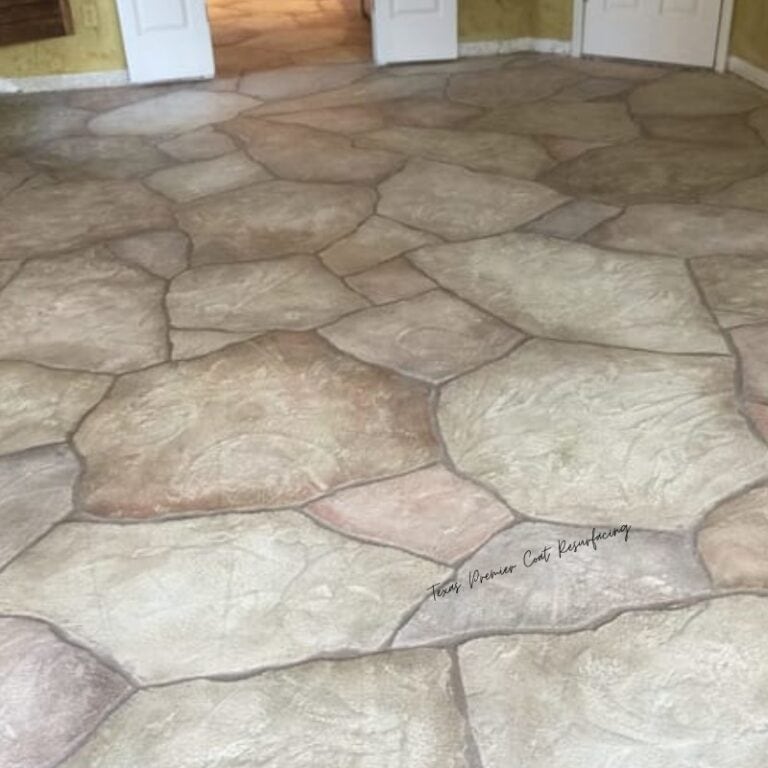
Hand-carved patterns move with your concrete
We carve our own grout lines by hand, so any cracks already in the concrete become part of the pattern instead of fighting it. If a slab is badly cracked, we usually recommend a flagstone pattern. Flagstone is random, like a stone that broke naturally instead of being cut in straight lines, so the cracks blend in. We also put a flexible material in the cracks, so if the concrete moves and a crack ever shows up again, the material moves with it.
Why you cannot un-crack stamped concrete
What matters is what happens after it cracks. Stamped concrete is not forgiving, whether it is a stamped overlay or an original stamped finish in a 4-inch slab. Once it cracks, you can never match it again, and you cannot make the repair look new. The crack is very obvious, and there is no way to work it into the pattern.
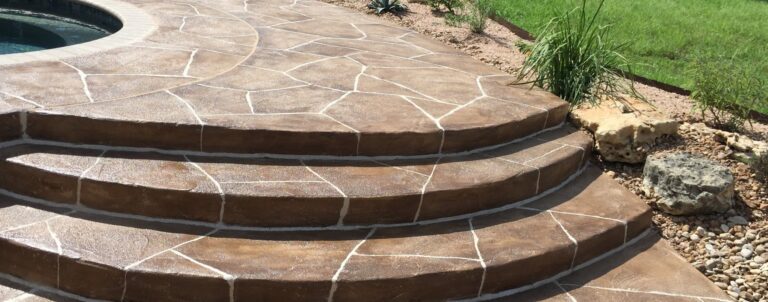
Good luck matching the stamp
There is another problem when you call to have a stamped surface repaired or add on to it: the stamp probably will not match. Stamps wear out. Most contractors rent them, and stamps are changed and upgraded every year. That makes it very hard to repair an existing pattern, so most contractors would rather tear the whole thing out and replace it. In our experience, that is a much bigger job for them than a repair.
A hand-carved overlay can be repaired year after year
The beauty of a hand-carved overlay is that it can be repaired again and again, even if your home has a lot of movement in the concrete underneath. Because we carve the pattern by hand, we can blend a repair so well that it is almost impossible for an untrained eye to find.
Heat: stamped concrete and pavers hold it
If this is for a pool deck or a patio you walk on barefoot, heat matters. In 2009, a Dallas custom pool builder tested our sample, a stamped concrete sample and pavers side by side. On average, our hand-tooled overlay measured about 30 degrees cooler than the stamped concrete or the pavers. We also tell customers who have small children or walk around barefoot to choose a light color, since lighter colors reflect more sunlight.
Already have stamped concrete?
If you already have a stamped patio or driveway, you have options. We reseal, repair and recolor stamped concrete.
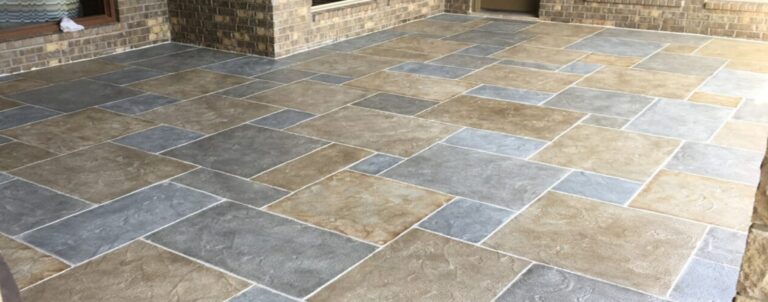
Where we do use a stamp
Stamping has a place in repair work. When a stamped area needs fixing, we use a different product made for it.
What it costs and how it compares
In our price comparisons, stamped concrete usually costs more. A stamped overlay starts at around $10 a square foot, and a full stamped pour on a 4-inch slab typically runs $17 to $20 a square foot. Austin Stone is $6 a square foot to start, depending on the pattern you choose and how much product goes down. Prices vary by contractor and by job, so treat these as a rough guide and get a written estimate.
Want to see it in person? Call 512-461-4836. We have jobs near you that you can drive by and look at, or we can arrange to take you to one. We resurface patios, driveways and pool decks in Austin, San Antonio and Dallas, with free estimates.

